
Urvina Bay & Tagus Cove
Both these sites lie along the western coastline of Isabela Island. Also known as “Albemarle,” this is the largest island in the Galápagos Archipelago, originally named in 1684 by Ambrose Cowley, scholar and buccaneer, for Christopher Monck, second Duke of Albemarle (1653-88), a known sympathizer of buccaneers and pirates. Shaped like a seahorse, it wraps itself around Fernandina Island, which we visited yesterday.
Both these islands rest above the “hot spot,” which means they could potentially erupt at any moment. Unfortunately, despite our best attempts at collective karma and mind-control, we couldn’t get an eruption going for today. But we still had an amazing visit, land iguanas and giant tortoises included!
An early landing at Urvina Bay had us on a dark beach which has been used heavily by sea turtles for the last four months. A Galápagos hawk was standing on the dark sand when we arrived (in hopes of an early hatching?). Walking inland, we came across land iguanas, and, as a special bonus, giant tortoises of the race from Alcedo Volcano.
Each and every volcano of Isabela Island is known for its own race of giant tortoise. With the heavy rains we have had this year, the vegetation is thick all the way down to shore, so the tortoises can find plenty to eat in the arid lowlands. Of course we were also on the lookout for land iguanas. These Alcedo Volcano reptiles spend most of their lives down in the arid lowlands and do not migrate as do the tortoises. They dig deep burrows in the earth where they can escape the cold nights of the dry season, or the heat and rain of the hot, wet season.
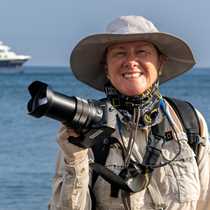
This week, the National Geographic Endeavour has a special cruise for photographers, so in addition to our local photographic instructors, we have the expertise of professional photographers Ralph Hopkins, Mike Nolan and CT Ticknor from Lindblad Expeditions, and Joel Sartori from National Geographic. All of them are available for advice and tips for getting better photographs and for understanding whatever camera one may have brought along, small or large.
This morning groups of photographers left early as they have done every morning at daybreak. The rest, also interested in good photographs but eager to hear more of the natural history of the area, left a bit later. We ALL came back with extraordinary memories (digital as well as mental) because there were land iguanas in the trail as well as giant tortoises wandering about. Poison apple seeds were found in their excrement, so we knew what they had had for a recent meal along with the other greenery in the area.
The afternoon was spent in another location up the coast known as Tagus Cove. For centuries, this protected bay has harbored vessels of all kinds. Up on the cliff sides, the names of ships and boats that have rested at anchor here over the years are written along the high, steep bluff. We did everything we could possibly fit in our schedule: kayaking (with Galápagos penguins and cormorants); snorkeling (with marine turtles and penguins); hiking (up a long trail with fantastic overviews); and Zodiac rides (when most penguins come out onto the rocks for the evening).
There was little left undone today, and tomorrow is coming up fast. Good night!